The forest, a living system
For several years, the forest has been at the heart of Clothilde Lasserre’s work. Not as a backdrop, but as a living system: a network of relationships, growth and resilience.
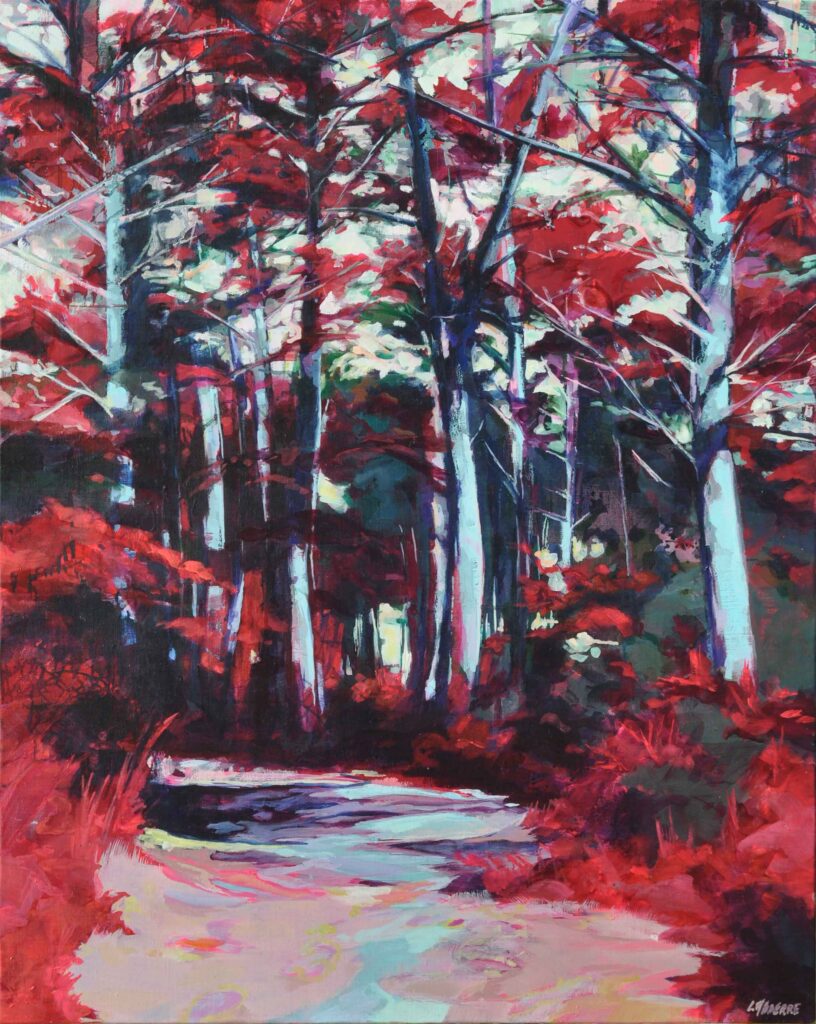
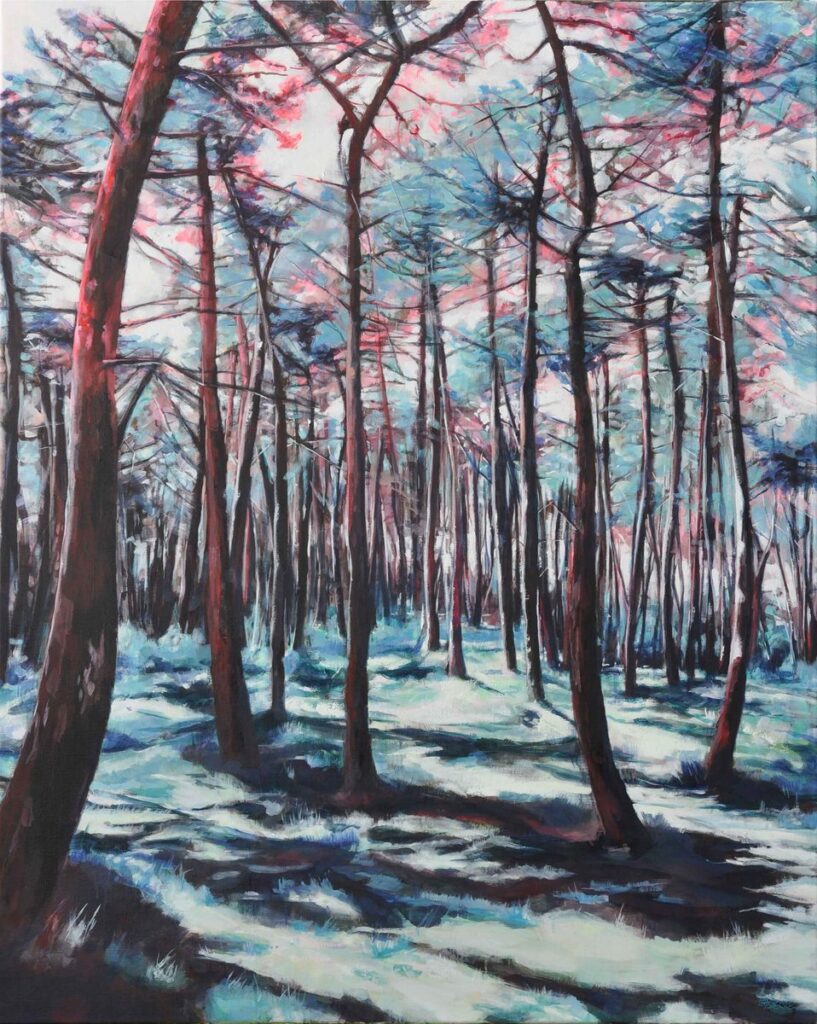
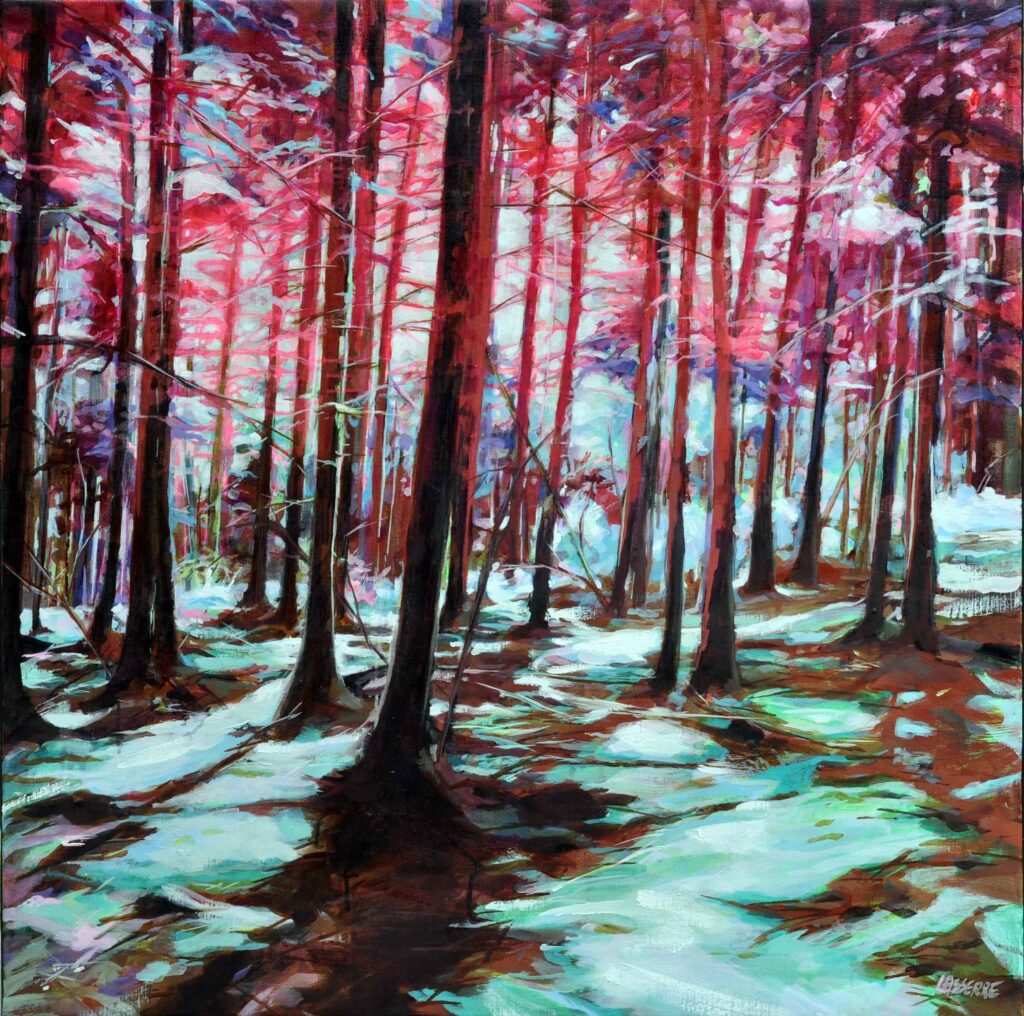
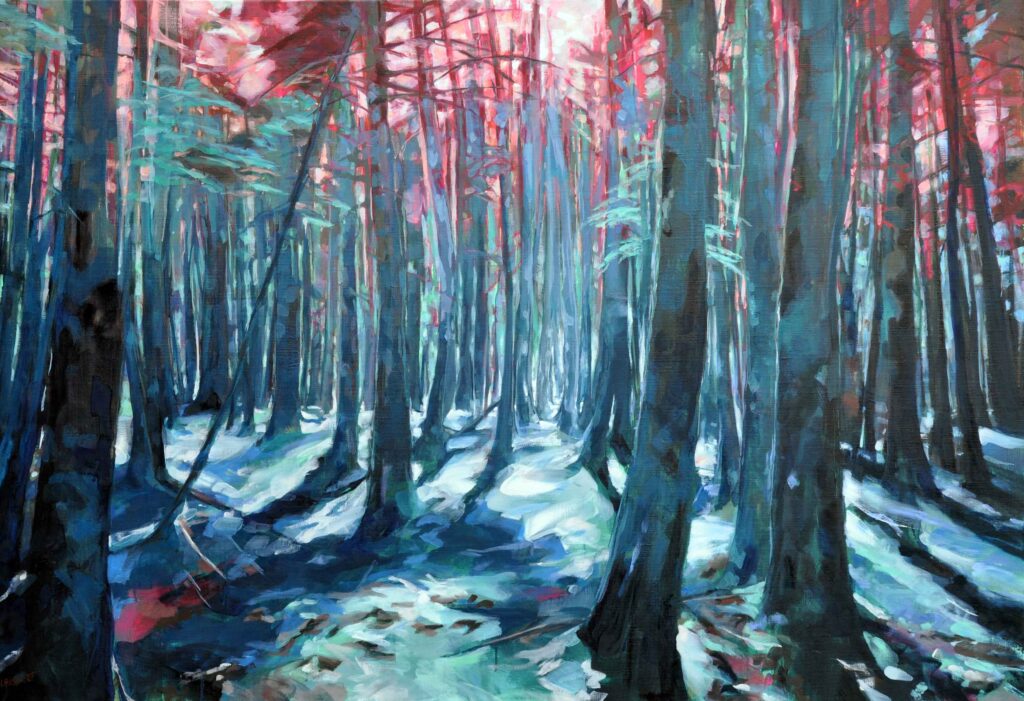
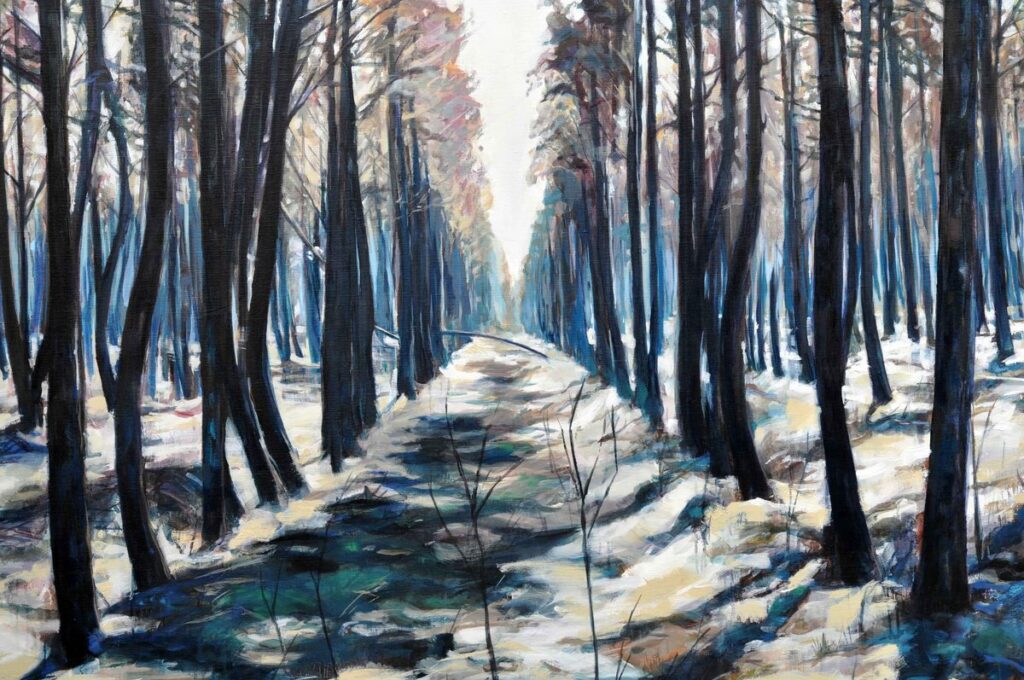
In the Nature series, she paints pine forests and undergrowth seen in perspective or from above, giving the eye a sense of vastness, like a canopy. The trunks set the rhythm of the canvas in tight verticals; light passes between them and settles on the ground in pale patches crossed by blue shadows.
The palette deliberately departs from the expected green. Blues, turquoises, pinks and red-browns do not describe the forest: they convey how it feels.
The series extends the question that runs through all her work: how each of us cultivates our singularity while belonging to a whole.
The crowds she painted from above become stands of trees. Each trunk is unique; none stands alone.
Beneath the bark, a society
A forest is not a collection of isolated trees competing for light. Underground, fungal filaments — mycorrhizae — connect the roots and redistribute water, carbon and warning signals.
The work of ecologist Suzanne Simard (Finding the Mother Tree, 2021) has shown that the largest trees, the “mother trees”, preferentially nourish the young seedlings around them. What looks like individual growth above ground is, seen from the soil, a collective phenomenon.
Clothilde Lasserre’s hypothesis is that our societies work on the same principle: beneath the visible surface of the individual, a web of solidarity — family, friends, work, community — connects and supports us, often as discreetly as the mycorrhizal network beneath a forest.
This was already Peter Kropotkin’s argument in Mutual Aid: A Factor of Evolution (1902): cooperation, as much as competition, drives survival.
Her paintings and sculptures seek to make this invisible part of life perceptible: what, in the forest as in our lives, stands only because it holds together.
Inspirations

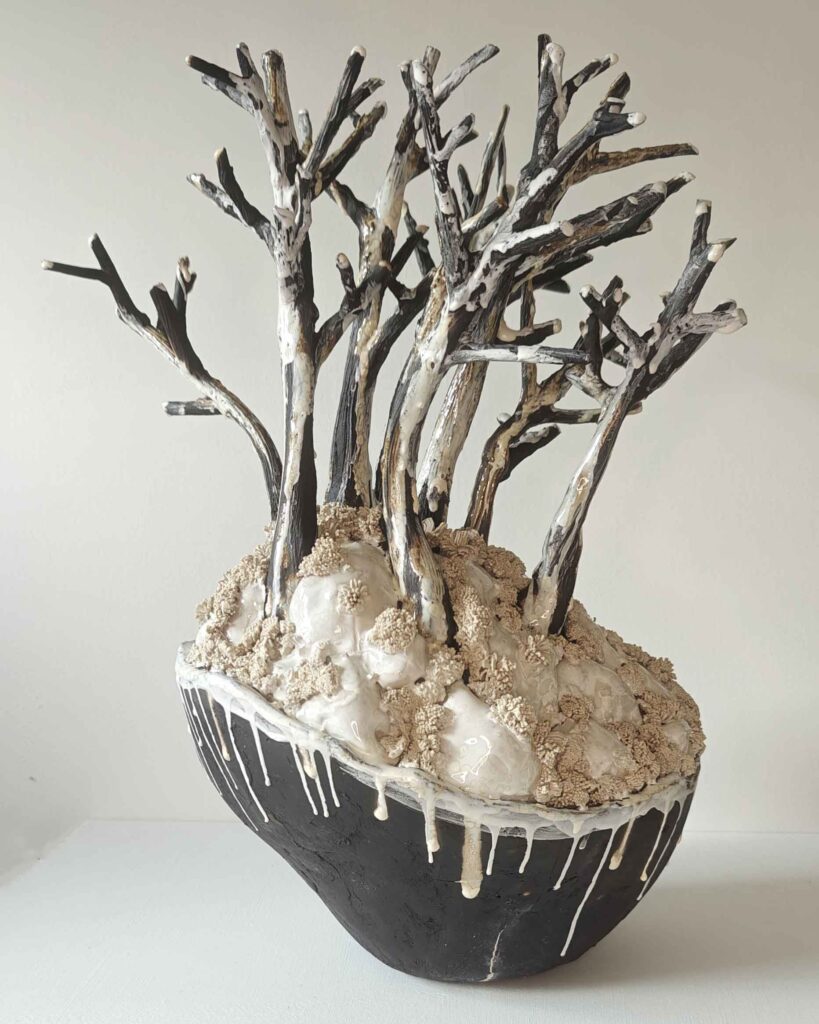
La forêt originelle — porcelain, H37 L33 P27 cm, 2025
Cooperation or competition?
All flourishing is mutual
In Braiding Sweetgrass, botanist Robin Wall Kimmerer takes mycorrhizae as a model for an economy of gift and reciprocity that can apply to human communities.
From this thinking, Clothilde Lasserre keeps a tension she seeks to show without naivety: the generosity of the model, and the rigour of the scientific facts behind it.
“All flourishing is mutual.”
Robin Wall Kimmerer – Braiding Sweetgrass (2013)
From burnt forest to renewal
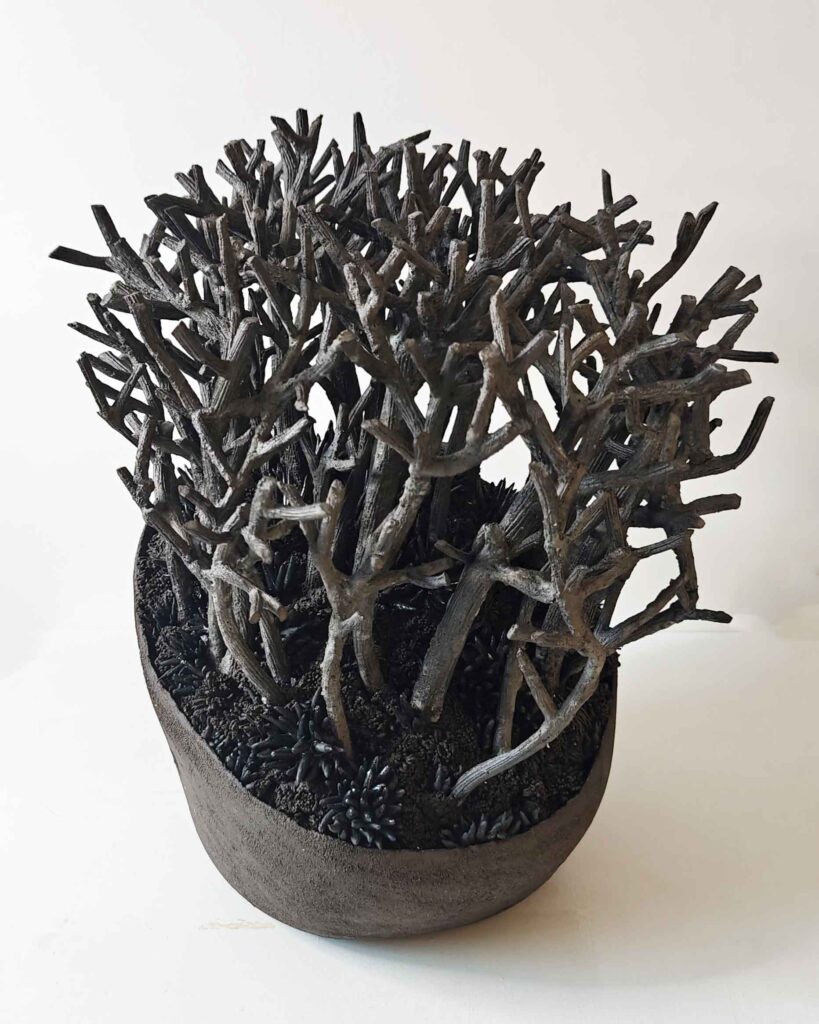
In sculpture, the series continues with the Burnt Forests. Renouveau (porcelain and stoneware, 2025) raises charred trunks from which moss and white buds emerge; La forêt originelle (porcelain, 2025) unfolds a white and green canopy, a fragile, luminous structure; Cocon de forêt uses black as a double memory: that of the fire, and that of the cocoon where something is preparing to be reborn.
Black stoneware evokes scorched earth; white porcelain, the fragility of what grows back. Together they hold the violence of fire and the gentleness of living things side by side, and question the resilience of ecosystems — and, by extension, of societies.
With a doctorate in applied mathematics, Clothilde Lasserre structures her compositions with a researcher’s rigour: networks, densities, points of connection. But it is the gesture that decides, between control and letting go, between realism and intuition.
Painting and sculpture thus tell the same story: that of a living world where nothing grows alone.